DNA Dreamers: Integrating DNA Evidence to Resolve Complex Cases

- Description
- Curriculum
This course is designed to deconstruct, and study researcher decisions, strategies, and methodologies employed in the correlation of documentary and genetic evidence to establish proven genealogical conclusions. Examples include case studies suitable for publication, research reports, and proof summaries/arguments useful in Kinship Determination (KD). The research problems are all long-standing genealogical brick walls that could not be solved without the skillful use of DNA and documentary sources. We focus on a variety of strategies to meet the DNA-Related standards and the Genealogical Proof Standard.
We will dissect familiar skills, with a DNA twist:
• Crafting a meaningful research question
• Developing and refining research plans
• Mining for evidence
• Correlating evidence
• Sorting and grouping evidence
• Analyzing with logic and inference
• Testing hypotheses
• Resolving conflicts
• Reporting of findings
• Writing clear proof arguments detailing evidence and reasoning to support the conclusion
The emphasis is on the strategies and decision-making each researcher employs to meet Genealogy Standards.
DNA Dreamers
Prior to SLIG, several lucky volunteers will provide a written summary of a real-life “stuck” case. During SLIG week, the class will study the written summaries and then participate in a “think-tank” about the various options for next steps. The focused discussion will help the volunteer choose THE BEST option using decision-making strategies based on Standards.
Golden Nuggets
The class will collaborate on a “Golden Nuggets Quicksheet” of handy tips and strategies learned throughout the week.
Monday, 25 January
8:00 – 8:30, Course Overview (Stanbary)
Lecture categories, tantalizing questions, DNA Dreamers, Golden Nuggets
8:30 – 9:45, Trivia: The Genealogical Proof Standard (Stanbary)
We begin the week with a fun trivia quiz designed to dispel the myths and thereby, bring the GPS into sharp focus.
10:15 – 11:30, Research Strategies and Decision-Making (Stanbary)
This lecture reviews scientific research principles. The concepts provide a framework for analysis of case examples throughout the week. Identification of decision-making points and multiple options are emphasized.
1:00 – 2:15, Genealogy Standards and Rubrics Part I (Stanbary)
Karen discusses Genealogy Standards within the context of tried-and-true genealogical research strategies. Rubrics will be presented with examples of Meets Standards, Partially Meets Standards and Does not Meet Standards. The emphasis is on developing a sound genealogical mindset with hands-on activities.
2:45 – 4:00, Genealogy Standards and Rubrics Part II (Stanbary)
4:15 – 5:30, DNA Dreamers (Stanbary, Jones, additional faculty TBD)
Throughout the week, we will discuss real-life case examples of volunteer participants. Each discussion will analyze a crucial decision point and brain-storm options for next steps in the research strategy.
Tuesday, 26 January
8:00 – 8:30, Coffee with Karen
Come join the discussion to evaluate your strengths and weaknesses.
8:30 – 9:45, Proving the Line by Generation—The Packer Case (McGhie)
Angela establishes biological proof of parentage for five generations of a well-documented Mormon pioneer family. This case correlates genetic evidence (atDNA, Big-Y) with documentary evidence including LDS church records, probate records and family compiled genealogies. The parentage proofs illustrate research strategies useful in Kinship Determination.
10:15 – 11:30, Chromosome Mapping and Misattributed Parentage—the Anonymous Case (Stanbary)
Karen demonstrates the use of negative evidence on a chromosome map to identify and solve an unsuspected case of 1922 misattributed parentage. Strategic targeted testing confirms the hypothesis.
1:00 – 2:15, Mitochondrial DNA Corrects Misattributed Parentage—The Overton-Klug Case (Jones)
Eleanor, born around 1750, left no record naming her parents. An article published in 2006 uses indirect evidence to identify them. Evidence from mitochondrial DNA (mtDNA) shows that identification was partially or entirely wrong. This case study demonstrates how to use mtDNA to solve unknown and misattributed parentage cases. It also addresses the accompanying difficulty of documenting multiple female-only lineages for many generations and the resulting success.
2:45 – 4:00, A Father for David: The Miller Case (Miller)
No records provide direct evidence that identifies the father of David Miller. Rigorous correlation and analysis of indirect evidence, combined with Y-DNA results prove that David’s father was Abraham Miller, born circa 1760.
4:15 – 5:30, DNA Dreamers (Stanbary, Jones, Faculty TBD)
Volunteer DNA Dreamers participate in a “Think Tank” to strategize next steps.
Wednesday, 27 January
8:00 – 8:30, Coffee with Karen
Come join the discussion to evaluate your strengths and weaknesses.
8:30 – 9:45, Visual Phasing—The Sonnemaker Case (Stanbary)
Karen illustrates the use of a visual phasing project to identify Sonnemaker chromosomal locations of three siblings. The visually phased segments are tagged to specific generational inheritance and correlated with documentary evidence to prove biological relationships. The case study explores an 1840’s immigrant Niedersachen community one day’s journey west of the infant trading city of Chicago. Karen provides an example of a documented Compiled Genealogy for the ancestral line incorporating Evangelical-Lutheran church records on both sides of the ocean, federal land records, and Civil War pension records.
10:15 – 11:30, Endogamy, Double-Cousins, a Mysterious Birth, and a Murder in Tennessee—the Evans Case (Larsen)
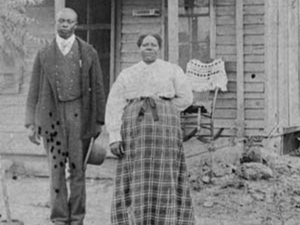
Martha B. Evans was born in Franklin County, Tennessee in either 1872 or 1873 to a mixed-race family that for generations was enumerated on federal censuses as either a mulatto or a free person of color. Family lore long claimed that Martha’s purported Evans father went away to collect wood, and when he returned years later (carrying the wood), he found Martha born in his absence. Her descendants speculated about her birth father’s identity. Some insisted he was killed by Martha’s aunt, mother, or sister. This case demonstrates the use of visual phasing and segment data to isolate Martha’s DNA and create a hypothesis. Finding the truth is complicated by intermarriage, illiteracy, and the paucity of records in the rural south during the late nineteenth century.
1:00 – 2:15, Mary Taylor’s Parentage: A Documentary and DNA Investigation (Green)
This case study explores the parentage of Mary Taylor, born around 1805 in Pennsylvania and married in Meigs County, Ohio, in 1827. Utilizing both documentary and DNA evidence, this study addresses challenges such as endogamy, pedigree collapse, and the complexities of researching across multiple geographies. It highlights the use of frequently overlooked records, including militia attendance records and court documents, to piece together Mary Taylor’s lineage.
2:45 – 4:00, Using DNA Tests to Identify the Unrecorded and Forgotten Parents of a Mixed-Race Child born around 1890 (Jones)
Two test-takers’ remarkably large amount of shared atDNA triggered research that led to common ancestors seven and eight generations earlier than the test takers. Getting to that point required not only atDNA but also Y-DNA and ethnicity testing, overcoming an unknown parentage situation by narrowing twenty-four Y-DNA-candidate fathers to one man, and an extraordinary amount of documentary genealogical research. This case also shows how genealogists can use seemingly random atDNA matches as the basis for posing and answering meaningful and challenging genealogical-research questions.
4:15 – 5:30, DNA Dreamers (Stanbary, Jones, Faculty TBD)
Volunteer DNA Dreamers participate in a “Think Tank” to strategize next steps.
Thursday, January 28
8:00 – 8:30, Coffee with Karen
Come join the discussion to evaluate your strengths and weaknesses.
8:30 – 9:45, The Power of Reasoning and Logic: The Everding Case Part I (Stanbary)
Linda, an adoptee, knew her birth mother based on a birth certificate. She sought the identity of her biological father. Using atDNA clusters and the power of syllogisms, Karen ruled out nine candidates to identify him. This case demonstrates how to communicate complex analysis incorporating DNA test takers into a Research Report that meets standards.
10:15 – 11:30, The Power of Reasoning and Logic: The Everding Case Part II (Stanbary)
1:00 – 2:15, Olof Olson—A Swedish Proof of Parentage Case (McGhie)
This case study correlates genetic evidence with documentary evidence through four generations to prove biological relationships. The case illustrates research strategies useful in kinship determination and addresses challenges such as name changes upon immigration and patronymic naming practices.
2:45 – 4:00, Grouping and Reconstructing Blended Families: The Brooks Case (Deeter)
The 1880 Michigan census identifies 91-year-old widow Catherine Brooks as the mother of 56-year-old John H. Allison. The 1870 Ohio census identifies 80-year-old Catherine Brooks living in the household of William T. Jones. A War of 1812 widow’s pension and bounty land application suggests these two Catherines are the same woman. Can DNA clusters untangle the relationships among her possible children and identify candidates for her biological parents?
4:15 – 5:30, DNA Dreamers (Stanbary, Faculty TBD)
Volunteer DNA Dreamers participate in a “Think Tank” to strategize next steps.
Friday, January 29
8:30 – 9:45, Writing Decisions Part I (Stanbary)
Karen will use case examples that show writing strategies to discuss DNA test results in reader-friendly prose. Examples include simple proofs with direct documentary evidence, proofs that discover and present unsuspected misattributed parentage, research reports that solve unknown parentage questions, and complex proof arguments.
10:15 – 11:30, Writing Decisions Part II (Stanbary)
Karen will guide the students through hands-on exercises deconstructing and evaluating written proofs integrating DNA and documentary evidence.
1:00 – 2:15, School of Hard Knocks (Stanbary, Jones, McGhie, Deeter, Green, Miller, Larsen)
Lecturers will describe the lessons each learned about research decisions at the “School of Hard Knocks.” There will be an opportunity for participants to ask the panel questions.
2:45 – 4:00, Golden Nuggets (Stanbary)
The class will work collaboratively to create a “Golden Nugget Quicksheet” — a handy summary of essential points learned throughout the week.




Classes held daily January 25-29, 8:00am-5:30pm Mountain time.
Course Coordinator:
Karen Stanbary, MA, LCSW, CG®, CGG®, BCG Trustee
Additional Faculty:
Kaelyn Deeter, BA, CG®
Shannon Green, CG® CGG®, CGL, BCG Trustee
Thomas W. Jones, PhD, CG®, FASG, FNGS, FUGA
David K. Larsen, PhD, MSLIS
Angela Packer McGhie, CG®, BCG Trustee
Moishe Miller
This is an ADVANCED methodology course. The prerequisite requires previous completion of the following full-week institute courses at any genealogical institute in two categories:
1—Advanced Methodology, Advanced Genealogical Methods, Mastering Genealogical Proof;
2—Beginning DNA, Introduction to Genetic Genealogy, Practical Genetic Genealogy, Proving Your Pedigree, Establishing Genealogical Proof with DNA, Intermediate DNA, Chromosome Mapping, Advanced DNA, or SLIG Virtual DNA Practicum. If a registrant does not meet the prerequisites, a work sample may be submitted for consideration that correlates genetic and documentary sources to establish a conclusion meeting the Genealogical Proof Standard.
Reading Requirements
Board for Certification of Genealogists. Genealogy Standards, 2nd ed. rev. Nashville,
Tenn.: Ancestry.com, 2021.
―――. Rubrics for Applications for Certified Genetic Genealogist, 1 July 2025, PDF, Board for Certification of Genealogists. https://bcgcertification.org/images/files/BCG-CGG-Application-Rubrics-2025 : 2026.
―――. Rubrics for Evaluating New Applications for BCG Certification, Part I, revised 1 July 2025; PDF, Board for Certification of Genealogists. https://bcgcertification.org/images/files/BCG-New-Application-Rubrics-Pt1.pdf : 2026.
―――. Rubrics for Evaluating New Applications for BCG Certification, Part II, revised 1 July 2025, updated 19 October 2025, PDF, Board for Certification of Genealogists. https://bcgcertification.org/images/files/BCG-New-Application-Rubrics-Pt2.pdf : 2026.
Mills, Elizabeth Shown. “Fundamentals of Research and Analysis” and “Fundamentals of Citation and Style.” In Evidence Explained: Citing History Sources from Artifacts to Cyberspace, 4th ed. Baltimore: Genealogical Publishing Company. 2024.
Pre-Reading Recommendations
Jones, Thomas W. Mastering Genealogical Proof, 2nd ed. Arlington, Va.: National Genealogical Society. 2026.
―――. Mastering Genealogical Documentation. Arlington, Va.: National Genealogical Society. 2017.
―――. “Reasoning from the Evidence.” In Professional Genealogy: Preparation, Practice, and Standards, edited by Elizabeth Shown Mills. Baltimore, Md.:
Genealogical Publishing Co., 2018.
Wayne, Debbie Parker, ed. Advanced Genetic Genealogy: Techniques and Case Studies. Cushing, Tx.: Wayne Research. 2019.