
- Description
- Curriculum
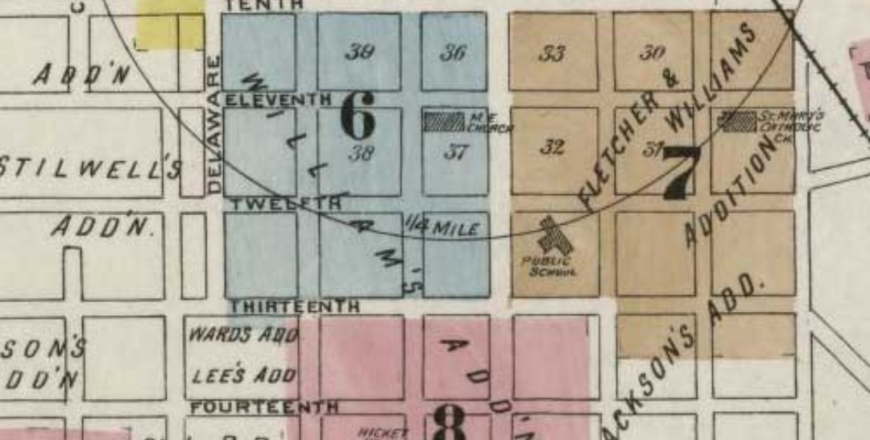
Understanding the physical and social landscapes where our ancestors lived can be crucial to solving problems of identity, kinship, and origin. This hands-on, advanced course, for students with experience in land records and platting, offers critical skills and practical strategies for constructing community networks around elusive ancestors. We’ll explore the integration of advanced land platting techniques with modern mapping technologies and historical maps to place ancestors in a specific location, trace the development of the neighborhoods in which they lived, and uncover insights into historical relationships and migration patterns. In-class examples and exercises will also demonstrate triangulation techniques for determining approximate location from partial data and the use of reconstructed ancestral networks to identify key associates, disambiguate same-name people, and locate “missing” individuals.
Weekly Progress Lab
Each week (except the first) begins with a short session to help you focus your efforts, reflect on what’s working (or not), and stay engaged with your research. We’ll walk you through examples, address your questions, and provide guidance to keep your research moving forward.
Week One (9 February):
10:30-11:45am, Getting Oriented: Paths Into a Neighborhood (Kimberly Powell)
Neighborhood reconstruction doesn’t always start with a plat map or deeds. This session introduces the many ways you can begin reconstructing a historical neighborhood using records you may already have, including deeds, census records, tax lists, probate files, and historical maps. We’ll look at examples of projects that started with different records and still led to meaningful discoveries. You’ll come away with flexible options for your own research and a simple framework to track your progress throughout the course.
12:15-1:30pm, Laying the Groundwork: Identifying Anchor Properties (Kimberly Powell)
A common challenge in neighborhood reconstruction is figuring out how to place a person—or any historical property—on a modern map. This session focuses on finding and working with “anchor” properties: known locations that help orient your neighborhood research geographically. We’ll cover practical strategies for identifying these starting points using historical maps, modern GIS tools, and property descriptions, as well as how to connect them to other individuals through deeds and surrounding context.
Week Two (16 February):
10:00-10:30am, Weekly Progress Lab
10:30-11:45am, Anchoring Ancestral Neighborhoods with GIS Resources (Kimberly Powell)
This session provides practical guidance on using GIS property maps as a starting point for neighborhood research. Learn how to access and interpret GIS resources and explore strategies for connecting modern parcels to historical deeds. Integrating GIS mapping with traditional land title research helps anchor our ancestral neighborhood to its physical location and can serve as a workaround for tracing properties with imprecise property descriptions.
12:15-1:30pm, Middle Ground: Researching Land Records in Both Directions (Kimberly Powell, Jerry Smith)
Learn techniques for tracing land ownership forward and backward from any point in time. This session will explore strategies for identifying landowners using deeds, grants, census, maps, and other records, helping you piece together families and communities.
Week Three (23 February):
10:00-10:30am, Weekly Progress Lab
10:30-11:45am, Putting the Neighborhood Together: A Guided Reconstruction Workshop (Kimberly Powell & Debbie Smyth)
In this two-session workshop, we’ll work through several neighborhood-reconstruction problems drawn from different localities and beginning from different entry points. As a group, we’ll consider what the available evidence tells us, what to pursue next, and which records, tools, and approaches may be most useful. Short individual activities will give participants a chance to work through particular steps or decisions before comparing approaches as a group. By working through several examples, participants will reinforce techniques introduced earlier in the course and gain more practice deciding how to apply them.
12:15-1:30pm, Putting the Neighborhood Together: A Guided Reconstruction Workshop (Kimberly Powell & Debbie Smyth)
Continuation of above.
Week Four (9 March):
10:00-10:30am, Weekly Progress Lab
10:30-11:45am, Bridging the Gaps: Working Around Missing Land Transactions (Kimberly Powell)
Discover effective strategies for overcoming record gaps when researching property forward or back in time. This session will explore common causes of missing records, how to use alternative sources, and creative problem-solving techniques to bridge these gaps effectively.
12:15-1:30pm, Organizing the Chaos (Kimberly Powell)
Neighborhood research quickly generates a flood of names, parcels, and documents. This session offers practical tools to help you stay organized and make sense of incomplete or scattered information. We’ll explore different approaches to managing research using a variety of tools, focusing on what to track and how to track it. You’ll learn how to set up a system that works for your goals and evolve it as your project grows.
Week Five (16 March):
10:00-10:30am, Weekly Progress Lab
10:30-11:45am, Solving Parentage & Identity Conflicts with Migration Cluster Research: Case Study Workshop – Part One (Rebecca Whitman Koford)
This interactive lecture follows a complex family group from Virginia to Georgia. Applied organizational methods clarified analysis and group migrations patterns assisted in correctly identifying one man’s parents and correcting the identification of other men in his cluster. Students will participate in organization and analysis exercises for this case study to find proof.
12:15-1:30pm, Solving Parentage & Identity Conflicts with Migration Cluster Research: Case Study Workshop – Part Two (Rebecca Whitman Koford)
Continuation of above.
Week Six (23 March):
10:00-10:30am, Weekly Progress Lab
10:30-11:45am, Reconstructing Communities with Census Records (Kimberly Powell)
Learn how to effectively use census records to reconstruct ancestral communities and place census neighbors on a map. This session will teach you how to map individuals enumerated in the census who do not appear on landowners’ maps and may not have owned land. Reconstructed neighborhood examples will also explore why census order does not always reflect neighborhood order.
12:15-1:30pm, Crucial Connections: Identifying Neighbors and Networks (Kimberly Powell, Jerry Smith)
Discover techniques for identifying the neighbors and social networks of your ancestors using diverse and often overlooked records. This session will build on the effective use of census data by incorporating historical maps, tax lists, legislative petitions, military records, store ledgers, court records, probate inventories, and other lesser-used sources to reconstruct the geographical and social landscape of your ancestors.
Week Seven (30 March):
10:00-10:30am, Weekly Progress Lab
10:30-11:45am, Mapping Urban Communities with QGIS: Part One (Colleen Robledo Greene)
These sessions will demonstrate techniques for reconstructing an urban community using historical maps overlaid on present-day jurisdictions and streets in QGIS. Although the case study focuses on a Mexican immigrant family network, the lessons are applicable to any urban community. Weaving in data from censuses, city directories, newspapers, and vital records, you’ll learn how to plot out where extended family groups lived and worked and get a better sense of the community in which they lived. You’ll also learn how digital tools like QGIS and Google Earth Web can reveal spatial patterns and connections between people and places.
12:15-1:30pm, Mapping Urban Communities with QGIS: Part Two (Colleen Robledo Greene)
Continuation of above.
Week Eight (6 April):
10:00-10:30am, Weekly Progress Lab
10:30-11:45am, Silent Neighborhoods: Mapping Ancestral Communities in American Cemeteries (Melinda Kashuba)
In this session, students will explore American cemeteries, where each gravestone tells a story. We’ll examine the history, design, and evolution of these grounds and how they reflect the cultural and social dynamics of their times. We’ll cover various methods for mapping cemeteries, including GPS tools like Billion Graves and Find a Grave. Students will learn to map cemetery neighborhoods, uncovering family, ethnic, and social connections of the past. Join us to understand the iconography and symbols on gravestones and discover how these silent neighborhoods can enhance your genealogical research.
12:15-1:30pm, Building a Rural Ohio Neighborhood: A Case Study (Rick Sayre)
This session will present a case study of reconstructing a nineteenth-century neighborhood in Meigs County, Ohio. You’ll see how land records from federal, state, and Ohio Land Company sources can be used to map out rural communities. The presentation will also demonstrate how other neighborhood records such as church, tax, and cemetery records contribute to reconstructing and understanding historical communities.
Week Nine (13 April):
10:00-10:30am, Weekly Progress Lab
10:30-11:45am, Philadelphia Catholics to Ireland (Jerry Smith)
Building the American neighborhood and community can provide the necessary leverage to locate the European village of origin for the family. This session provides a case study where reconstruction in American church records leads to family origin in Ireland.
12:15-1:30pm, Using Federal Records to Help Map Rural Neighborhoods (Kimberly Powell)
Yes, federal records can also help reconstruct and map rural communities. This session will cover lesser-used federal resources, including records from the Southern Claims Commission and U.S. Court of Claims, the Freedmen’s Bureau, the Works Progress Administration, and the Internal Revenue Service, and provide practical techniques for integrating these and similar materials into your neighborhood research.
Week Ten (20 April):
10:00-10:30am, Weekly Progress Lab
10:30-11:45am, Incorporating Industrial Records (Jerry Smith)
Industry practices as early as the 1700s resulted in industry and business records that can assist in reconstructing communities. Company towns, banks, and industrial records are resources. Discussion includes repositories for industrial records.
12:15-1:30pm, Making Sense of Your Discoveries & Next Steps (Kimberly Powell)
Your project may still feel incomplete, and that’s okay! Network research can take a lot of time. In this session, we’ll focus on the connections you did find—what patterns emerged, what surprised you, and how mapping those relationships helped clarify (or complicate) your original questions. We’ll also talk about making sense of gaps, deciding what’s worth pursuing next, and recognizing that even messy, partial discoveries can offer valuable insights.



Class sessions are held Tuesdays, February 9-April 20, 10:00am-1:30pm Mountain Time.
Course Coordinator:
Additional Faculty:
Colleen Robledo Greene, MLIS, FTxSGS
Melinda Kashuba, PhD
Rebecca Whitman Koford, CG, CGL
Rick Sayre, CG, CGL, FUGA
Gerald H. “Jerry” Smith
Debbie Wilson Smyth