
Blog
Corpus Juris: Advanced Legal Concepts for Genealogy
Why Did She Need a Court’s Permission to Raise Her Own Children?
You find it in the probate file: after her husband’s death, your ancestor petitioned the court to be appointed guardian of her own children. It seems strange, even insulting. Weren’t they already hers?
Under the law of the time, not necessarily. Custody of a child and legal authority over that child’s property were two different things, and when children inherited from their father, a mother often had no automatic right to manage what they inherited. The court had to appoint someone, and that someone wasn’t always her.
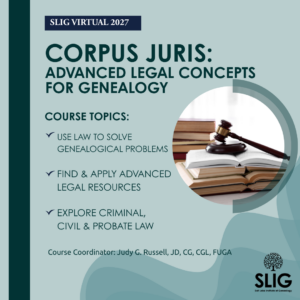
Moments like this are everywhere in genealogy: an ancestor who did something that makes no sense until you know the law they were living under. Corpus Juris: Advanced Legal Concepts for Genealogy gives you the skills to find that law and apply it.
Find the law in effect at the time
Laws changed constantly, and the rule that applies today may have been completely different in your ancestor’s county in 1820. The course walks through finding and reading the statutes and session laws in force at a specific time and place. It also covers the civil law tradition behind records in places like Louisiana and much of Europe, including notarial records, which are a goldmine in civil law countries.
Your family’s dispute might be in a law book
When a family fight over an estate, a debt, or a boundary went to appeal, the court often published the decision, sometimes with details found nowhere else. Sessions on appeals courts, digests, and reporters show you how to find those cases. Then students go hands-on with the resources of a major legal research service, the kind usually available only at law libraries or by subscription.
Every corner of an ancestor’s legal life
Individual sessions take on the areas of law where ancestors turn up most often:
- Family law, and the full range of records it created
- Probate, in a hands-on session
- Debt, and what happened to those who couldn’t pay
- Criminal records, from prosecution to parole
- Immigration and naturalization, and the laws behind them
- Church law, and when the church said yes or no
- Private laws, where Congress acted on behalf of a single person
- Slavery’s legal history and its implications for research
- Legal research before statehood
Learn from the experts
Judy Russell, JD, CG, CGL, FUGA, leads the course, joined by LaBrenda Garrett-Nelson, Forrest Hansen, David McDonald, and Thomas Jones.
Join us
Corpus Juris: Advanced Legal Concepts for Genealogy runs January 25–29, 2027, as part of the virtual Salt Lake Institute of Genealogy. Find out what the law was and what it meant for your family.