
Blog
DNA Dreamers: Integrating DNA Evidence to Resolve Complex Cases
The Daughter Who Didn’t Quite Fit
Imagine this: in the 1880 census, three-year-old Ellen is listed as the daughter of James and Mary Carter. But James and Mary didn’t marry until 1879, and nothing suggests James had an earlier wife. The family story says Ellen was “a cousin’s girl they took in,” though no one ever said which cousin.
Then Ellen’s great-granddaughter takes a DNA test. Her matches include several people she’s never heard of, all descended from a family two counties away. None of them are Carters.
So who were Ellen’s parents? Is the family story true, partly true, or covering for something else? The documentary evidence can’t say. The DNA matches can’t say on their own either. But used together, with careful reasoning, they can point to an answer, and a proof strong enough to stand up to scrutiny.
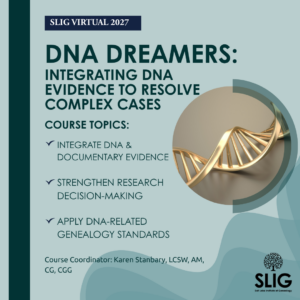
Every experienced genealogist has a case like Ellen’s. DNA Dreamers: Integrating DNA Evidence to Resolve Complex Cases teaches you how to solve them.
Real brick walls, taken apart
Every case in this course is a long-standing problem that couldn’t be solved without DNA and documentary research working together. Instructors don’t just show the answers. They walk through the decisions: why they chose this test, this record, this next step, and how each choice met genealogical standards.
The cases span the full DNA toolkit:
- A 1922 misattributed parentage uncovered through negative evidence on a chromosome map
- Mitochondrial DNA overturning a published answer about an 18th-century woman’s parents
- Y-DNA narrowing twenty-four candidate fathers down to one man
- Visual phasing used to trace a 19th-century German immigrant family
- An adoptee’s biological father identified by ruling out nine candidates through logic
- A 91-year-old widow appearing in two states, and DNA clusters used to untangle her blended family
Bring your own stuck case
Before SLIG begins, a few volunteers submit a written summary of a real case they can’t move forward. Each afternoon, the class and faculty act as a think tank, weighing options and helping the volunteer choose the best next step using standards-based decision-making. Even if you don’t volunteer, watching experts reason through someone else’s live problem is one of the best ways to sharpen your own.
Standards, logic, and writing
The week opens with a trivia quiz that clears up myths about the Genealogical Proof Standard, followed by sessions on research strategy and rubrics that show what meeting the standards actually looks like. It closes with two sessions on writing about DNA in clear, readable prose, from simple proofs to complex arguments.
Along the way are optional morning coffee sessions with the course coordinator, a “School of Hard Knocks” panel where instructors share lessons learned the hard way, and a Golden Nuggets quick sheet the class builds together to take home.
Learn from the experts
Karen Stanbary, LCSW, AM, CG, CGG, leads the course, joined by a faculty of case study authors including Angela McGhie and instructors Jones, Miller, Larsen, Green, and Deeter.
Join us
DNA Dreamers runs January 25–29, 2027, as part of the virtual Salt Lake Institute of Genealogy. Afternoon think-tank sessions run until 5:30 p.m. Mountain time.