
Blog
Becoming an Accredited Genealogist Professional
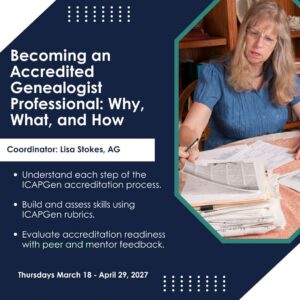
You won’t spend this course taking notes while someone lectures about accreditation. Every Thursday session of the ICAPGen Accreditation Preparation course ends with homework, and that homework is the real work: your own research, your own sources, and the skills the exam actually tests. Each week builds on the last, so over seven weeks you produce a body of work and have it reviewed by classmates and Accredited Genealogists, instead of just hearing how it’s done. Class sessions are held Thursdays, March 18-April 29, 8:00am-2:45pm Mountain Time. From week one, you’ll be applying the ICAPGen rubrics to real work, your own and your classmates’.
What you’ll do
- Write and evaluate source citations, then compile your own set of citation templates
- Outline one generation of your Four Generation Project
- Write a proof summary or proof argument for that project, then peer review a classmate’s using ICAPGen rubrics
- Build a research log and compare the platforms you can use to keep one
- Plan and outline your Personal Reference Guide, after studying examples from instructors and past students
- Find a record from your chosen accreditation region, then transcribe and abstract it
- Practice research planning and receive feedback on your approach
- Complete a four-hour practice Final Project for your region, then review another student’s
- Practice for the Document Interpretation and General Knowledge exams, including writing ten study questions to share with the class
- Meet with an AG mentor from your chosen region, or a similar one, for research tips and testing guidance
What you’ll take away
By the end of the seven weeks, you’ll have more than a clearer picture of the accreditation process. You’ll have working drafts of the pieces ICAPGen asks for: citations, a proof argument, a research log, a reference guide, and a completed practice Final Project, all reviewed by people who know the rubrics. You’ll understand what is expected for the Oral Review and the ICAPGen Professional Ethics Agreement. You’ll also know where your work is strong and where it needs attention before you test, and you’ll have spoken with an Accredited Genealogist who has researched in your region. The course closes with a panel of AG professionals and a goal-setting session, so you leave with a plan for what comes next rather than a vague intention. For many candidates, the most valuable thing the course offers is an honest answer to the question “Am I ready?”