Blog
Death in Context: Exploring Records, Burial Practices, and Memorial Landscapes in America (Part 1
The Stone Is Telling You More Than Dates
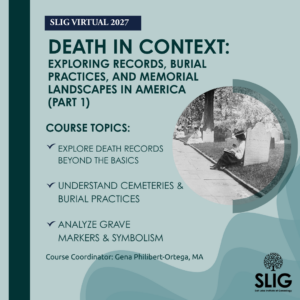
You’ve probably stood in front of a stone like this: a weeping willow bending over an urn, a name, two dates, and at the bottom a line many old stones share: “Where I am, you will one day be.”
Most of us take a photo, note the dates, and move on. But that stone is an artifact. Its carving, its material, its symbols, and even its place in the cemetery were all choices, shaped by the era, the region, the family’s faith, and what they could afford. Read closely, a grave marker can tell you when it was likely made, what the family believed, and sometimes who they were connected to.
And the stone is only the beginning. Death in Context: Exploring Records, Burial Practices, and Memorial Landscapes in America (Part 1) shows you how much more death can reveal about an ancestor’s life.
The records behind a death
Death is one of the best-documented events in an ancestor’s life, but most researchers use only a small part of that documentation. The course starts with the familiar death certificate and asks why it contains what it does, what it leaves out, and what’s hidden in plain sight.
From there, the week moves through the full paper trail: probate and inheritance records, cemetery records like sexton books and burial registers, church death registers, newspaper coverage well beyond the obituary, and the census, which reveals deaths far beyond the mortality schedules.
One session looks at the ancestors who are hardest to find: those buried in potter’s fields, institutional cemeteries, and unmarked graves, and the records that may still document where they rest.
Not all cemeteries are the same
The second half of the week turns to the cemeteries themselves, and how time, place, religion, and circumstance shaped them. You’ll explore early American carvers, the 19th-century garden cemeteries that became destinations in their own right, and the 20th-century memorial parks with their flat markers.
Dedicated sessions cover military burials and memorials, African American cemeteries and the ongoing work to preserve them, reading Jewish cemeteries and Hebrew inscriptions, and Chinese cemeteries in North America, including the practice of returning remains to China.
Learn to read the stones
The course closes with two sessions on analyzing grave markers, drawing on symbolism, religion, art history, geology, and more. Then students can present their own work, such as an analysis of a marker or a cemetery topic of their choice, and learn from one another.
Learn from the experts
Gena Philibert-Ortega, MA, MAR, leads the course, joined by Amy Urman, Paul Graham, Sunny Jane Morton, Marian Pierre-Louis, KB Barcomb, Ari Wilkins, Tammy Hepps, and Carly Lane Morgan.
Part 1 of a two-part series
This course covers records, cemeteries, and grave markers. Part 2 explores the social history of death, including funerals, mourning, and health. Taking Part 1 (this version or the earlier one) is required before registering for Part 2.
Join us
Death in Context (Part 1) runs January 25–29, 2027, as part of the virtual Salt Lake Institute of Genealogy.