
Blog
SLIG VIRTUAL: AFRICAN AMERICAN RESEARCH
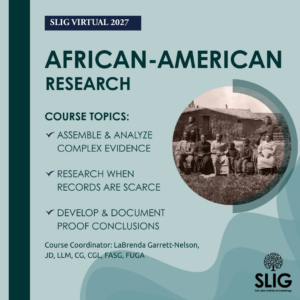
For many researchers, the story stops at the same place. You find your ancestors in the 1870 census, named and together as a family, and then, one census earlier, they seem to vanish.
There’s a reason for that. The 1870 census was the first federal census to record most formerly enslaved people by name. Before emancipation, enslaved people usually appeared in the census only as a line of numbers under the name of the person who enslaved them: an age, a sex, a color, and no name at all.
It’s easy to conclude that the trail ends there. It doesn’t. It becomes a different kind of trail, and learning to follow it is exactly what this course is built for.
Following the law to the records
Because the law treated enslaved people as property, their lives were recorded where property was recorded: in probate files, estate inventories, deeds, and tax lists. These records are painful to read, but they often hold names, ages, and family groupings that appear nowhere else.
The course begins with the history and law of American slavery for that reason. Once you understand how the legal system worked, you know where to look. From there, the week moves into probate records, estate inventories, manuscript collections, and land records, with case studies that show how experienced researchers reconstruct families from freedom back into slavery.
Meeting the Genealogical Proof Standard
Records from the slavery period rarely state a relationship outright. Research here depends on indirect evidence: correlating many small clues until they point clearly to one conclusion. Several case studies focus on that skill, and Friday’s two-part session shows how DNA can support, but not replace, a documented proof argument.
Communities other courses leave out
Not every family’s story runs through the plantation South. The course includes sessions on records unique to Louisiana Creole families, Native American Freedmen, and people with roots in the West Indies. If your research leads to New Orleans, Indian Territory, or the Caribbean, you’ll find focused guidance here that’s hard to find anywhere else.
Learn it, then practice it
This is a working course. There’s homework, in-class exercises, and a closing roundtable where instructors LaBrenda Garrett-Nelson, Deborah A. Abbott, and Scott Wilds take on students’ hardest research questions. Start writing yours down now.
Instructors include LaBrenda Garrett-Nelson (coordinator), Judy G. Russell, Scott Wilds, Deborah A. Abbott, Jari C. Honora, and Diane M. Warmsley.
Join us
African American Research runs January 25–29, 2027, as part of the virtual Salt Lake Institute of Genealogy. Take the course from home, with your own research files within reach.